
Tennis Odds Movement API: Track Line Movement, Steam Moves & Closing Odds
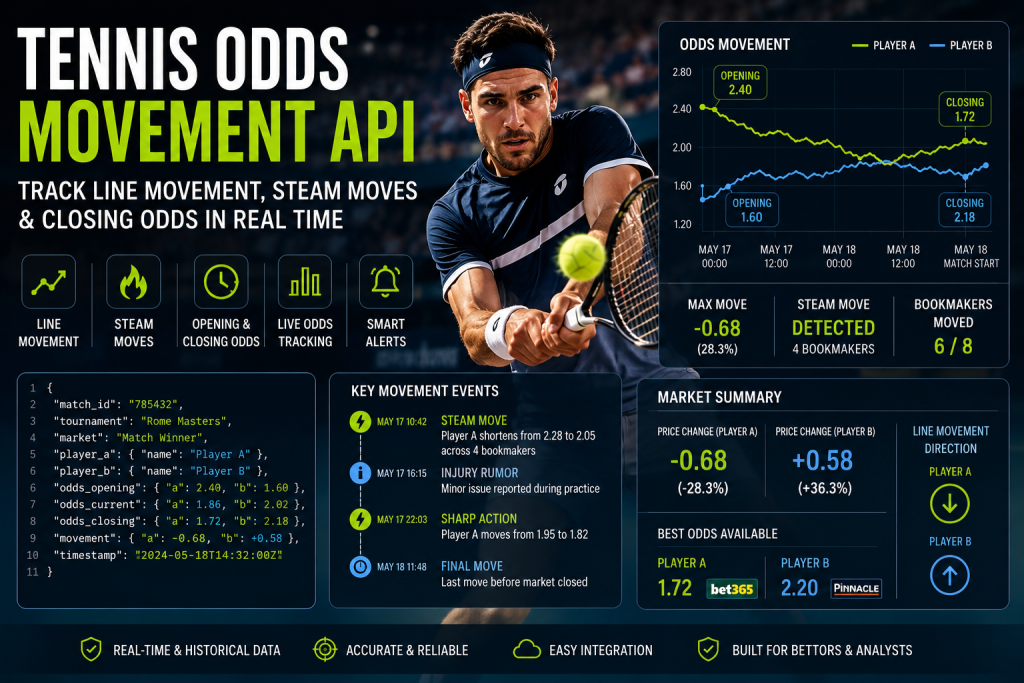
A complete guide for developers, betting analysts, trading teams, sportsbook tools and tennis data platforms that want to monitor price movement, identify steam moves, compare opening and closing odds, and understand how tennis betting markets shift over time.
Introduction
A tennis odds movement API gives developers and analysts a structured way to track how tennis betting prices change over time. Instead of only displaying the latest odds, it shows the market journey: where a price opened, how it moved, when it moved, which bookmaker moved first, whether the move spread across the market, and where the price finally closed before the match began.
This matters because tennis betting markets are constantly reacting to new information. A player may open at 2.30, shorten to 2.05 after early betting activity, move to 1.90 after sharper action, and close at 1.82 shortly before the match. Once the match begins, the same player may trade at 1.35 after an early break of serve, drift back to 2.20 after losing the first set, and move again during a deciding-set tiebreak.
A static odds feed cannot explain that story. A tennis odds movement API can. It allows products to track line movement, detect steam moves, compare opening and closing prices, monitor live market shifts, evaluate closing line value and build richer betting dashboards.
For serious tennis data products, odds movement is not just a visual feature. It is a market signal. It helps explain what the betting market is doing, when confidence is changing and whether price movement may be linked to information, liquidity, public betting pressure or sharp action.
This article explains how a tennis odds movement API works, which fields matter, how to track line movement, how to identify steam moves, how to use closing odds, and how to build stronger tennis betting products around historical and live market movement.
What Is a Tennis Odds Movement API?
A tennis odds movement API is a data service that captures and returns changes in tennis betting odds over time. Instead of providing only a current price, it preserves price snapshots so developers can reconstruct how the market moved before and during a match.
A standard tennis odds API may answer the question, “What are the odds right now?” A tennis odds movement API answers a more valuable set of questions:
- What were the opening odds?
- What are the current odds?
- How much has the price moved?
- When did the movement happen?
- Which bookmaker moved first?
- Did the movement spread across multiple bookmakers?
- Was the move gradual or sudden?
- What were the closing odds?
- How did live odds move after key match events?
This makes odds movement data useful for betting dashboards, market monitoring tools, trading alerts, model validation systems, value detection workflows and SEO-focused betting content.
Why Tennis Odds Movement Matters
Odds movement matters because betting prices are not random. Markets move when new information appears, when money enters the market, when bookmakers manage risk, when liquidity changes or when live match conditions shift.
In tennis, market movement can be especially meaningful because the sport is highly sensitive to individual player condition. A small injury rumor, late schedule change, surface concern or fatigue factor can significantly affect a player’s expected performance. Unlike team sports, there is no bench of substitutes. If a player is not physically right, the entire market can change quickly.
Tennis odds may move because of:
- Injury or fitness information
- Player withdrawal concerns
- Late schedule changes
- Surface or weather conditions
- Sharp betting activity
- Public support for a popular player
- Bookmaker risk adjustments
- Low-liquidity markets
- Live score changes
- Medical timeouts during a match
- Momentum swings in key games or tiebreaks
A tennis odds movement API gives teams the data needed to study those changes instead of guessing. It can show whether a price move was isolated to one bookmaker or whether the entire market moved in the same direction.
Opening Odds: The First Market Signal
Opening odds are the first prices made available for a match. They represent the market’s earliest estimate of each player’s chance of winning. Opening prices are important because every later move is measured against them.
If a player opens at 2.50 and later closes at 2.00, the market has moved significantly toward that player. If another player opens at 1.60 and closes at 1.90, the market has moved against that player. These changes are important for analysts because they show how market opinion developed before the match started.
Opening odds can help answer:
- Were early prices weaker than closing prices?
- Which tournaments produced the largest opener-to-close movement?
- Do certain players regularly shorten after markets open?
- Are lower-level markets more volatile?
- Does a model find more value at opening price or closing price?
Opening odds are also useful for content. A betting preview can explain that a player opened as an underdog but has shortened sharply, giving users more context than a simple current price.
Current Odds: The Market Right Now
Current odds show the latest available price at the time of the API request. They are useful for odds comparison pages, live betting products, dashboards and alerts. However, current odds are much more informative when shown alongside opening and closing context.
A player priced at 1.80 may look like a normal favorite. But if that player opened at 2.40, the current price tells a stronger story. It shows the market has moved heavily toward that player. If the same player opened at 1.45 and drifted to 1.80, the story is completely different.
This is why odds movement data is more valuable than current odds alone. The latest price is only one frame. Movement data is the full timeline.
Closing Odds: The Key Benchmark
Closing odds are the final meaningful pre-match prices before the match begins. In betting analytics, the closing price is one of the most important benchmarks because it usually reflects the most mature pre-match market view.
Closing odds matter for several reasons:
- They help measure closing line value.
- They show where the market settled before play.
- They help evaluate model quality.
- They provide a benchmark for opening odds accuracy.
- They reveal whether late market movement confirmed or rejected earlier prices.
A model that consistently beats the closing line may be identifying value before the wider market adjusts. For example, if a model recommends Player A at 2.20 and Player A closes at 1.95, the model captured a better price than the final pre-match market. That does not guarantee the bet wins, but it is a positive long-term signal.
A tennis odds movement API should make closing odds easy to identify by providing a clean final pre-match snapshot, timestamp, bookmaker source, market status and match start time.
What Is a Steam Move in Tennis Betting?
A steam move is a fast and meaningful odds movement, often across multiple bookmakers. It may indicate influential money entering the market, a rapid market correction or new information being priced in quickly.
In tennis, steam moves can happen before a match or during live play. A pre-match steam move may happen when a player suddenly shortens across the market. A live steam move may happen after a service break, injury signal, medical timeout or sudden shift in performance.
To detect a steam move, an API or internal system should consider:
- How quickly the price moved
- How large the movement was
- How many bookmakers moved
- Whether the move was in the same direction across the market
- Whether the movement happened close to match start
- Whether market suspension occurred
- Whether live score context explains the move
Steam moves should be treated carefully. Not every fast move is sharp. Some moves may be driven by low liquidity or public betting. A strong odds movement API gives analysts the raw data to separate meaningful steam from ordinary noise.
Line Movement vs Steam Moves
Line movement and steam moves are related, but they are not the same. Line movement refers to any change in odds over time. Steam moves refer to faster, more aggressive and often broader market movement.
A gradual move from 2.10 to 1.95 over two days is line movement. A sudden move from 2.10 to 1.80 across several bookmakers in a few minutes may be a steam move.
A tennis odds movement API should support both types of analysis. Developers may want to show normal line movement charts for user-facing pages, while also running alert logic in the background for sudden moves.
Useful alert thresholds might include:
- Price shortens by more than 10% within 15 minutes
- Three or more bookmakers move in the same direction
- Market-implied probability changes by more than five percentage points
- Favorite becomes underdog or underdog becomes favorite
- Major movement happens within one hour of match start
- Live odds swing sharply after a break point or service break
Converting Odds Movement into Implied Probability Movement
Odds movement is easier to understand when converted into implied probability. Decimal odds can be converted with:
implied_probability = 1 / decimal_oddsA move from 2.50 to 2.00 is a move from 40% implied probability to 50%. A move from 1.80 to 1.50 is a move from 55.6% to 66.7%. Probability movement is often easier to chart and compare than raw odds movement.
This is especially useful across different price ranges. A move from 10.00 to 8.00 may look large in odds format, while a move from 1.30 to 1.20 may look small. Implied probability helps normalize the comparison.
A strong tennis odds movement dashboard should show both price movement and implied probability movement. Price is what bettors see. Probability is what analysts use.
Key Fields a Tennis Odds Movement API Should Provide
Odds movement analysis depends on clean and precise data. A serious API should not simply return prices. It should return structured records that can be joined, sorted, filtered and compared.
Important fields include:
- Match ID: Stable identifier for each match.
- Player IDs: Stable identifiers for both players.
- Tournament ID: Useful for event-level grouping.
- Tournament name: Human-readable event label.
- Tour category: ATP, WTA, Challenger, ITF or Grand Slam context.
- Surface: Hard, clay, grass or indoor court context.
- Bookmaker ID: Source of each price.
- Market type: Match winner, set betting, totals, handicap or outright.
- Outcome: Player or market outcome tied to the price.
- Odds value: Decimal, fractional or American price.
- Timestamp: Exact time the price was captured.
- Opening flag: Whether the price is the opener.
- Closing flag: Whether the price is the final pre-match line.
- Live flag: Whether the odds were captured during play.
- Market status: Active, suspended, closed or settled.
- Score state: Current match score for live odds, where available.
Timestamps and market status are especially important. A price that appears during market suspension may not be truly available. A price without a timestamp cannot be trusted for movement analysis.
Using Official Tennis Context with Odds Movement
Odds movement becomes more meaningful when it is connected to tennis context. Tournament level, surface, draw position, match format and player schedule can all affect market behavior.
Developers should consider using official tennis sources as context for product design and event structure. The ATP Tour and WTA Tennis provide official context for professional men’s and women’s tennis schedules, events and player information. For Grand Slam-specific context, the official Wimbledon site is a useful reference for tournament structure, match environment and event-level coverage.
A betting product should not treat all tennis matches the same. A Grand Slam main draw match has different liquidity and public interest from a lower-level qualifying match. A grass-court match at Wimbledon may behave differently from a clay-court match or an indoor hard-court event. Market movement should be interpreted with that context in mind.
Pre-Match Odds Movement vs Live Odds Movement
Pre-match and live odds movement should be analyzed separately because they are driven by different types of information.
Pre-Match Movement
Pre-match movement happens before play begins. It may be driven by betting activity, player news, schedule changes, surface expectations, injury concerns, market liquidity or bookmaker risk management.
Live Movement
Live movement happens after the match starts. It is driven by score state, player performance, momentum, medical issues, service pressure, return dominance, tiebreaks and market suspension behavior.
A move from 2.20 to 1.60 before a match may suggest strong pre-match confidence. A move from 2.20 to 1.60 during the match may simply mean the player broke serve or won the first set. The same numerical move can mean very different things depending on timing.
This is why a tennis odds movement API should clearly separate pre-match and live prices.
Building a Tennis Odds Movement Dashboard
A tennis odds movement dashboard should turn raw price changes into useful insight. The goal is not simply to display a long table of odds updates. The goal is to show what changed, when it changed and why it may matter.
A strong dashboard might include:
- Opening odds
- Current odds
- Closing odds
- Price movement chart
- Implied probability movement chart
- Bookmaker-by-bookmaker comparison
- Largest movers
- Steam move alerts
- Market suspension indicators
- Live score context
- Closing line value summary
- Model probability comparison
For users, the interface should make movement easy to understand. A simple message such as “Player A opened at 2.40 and has shortened to 1.95 across four bookmakers” is far more useful than a raw list of price updates.
Using Odds Movement for Closing Line Value
Closing line value is one of the most important uses of odds movement data. CLV compares the price taken by a model, bettor or recommendation system against the final pre-match closing price.
For example:
- A model recommends Player A at 2.20.
- Player A closes at 1.95.
- The model beat the closing line.
Over a large sample, consistently beating the closing line can suggest that the model is identifying value before the market fully adjusts. This is not the same as guaranteeing profit, but it is a strong performance signal.
A tennis odds movement API should make CLV tracking easy by preserving recommendation-time odds, closing odds, timestamps, bookmaker information and final match results.
Using Odds Movement for Model Validation
Odds movement can help validate tennis betting models. A model should not only be judged by win rate. Tennis match outcomes are noisy, so short-term results can be misleading.
Better validation metrics include:
- Closing line value
- Probability calibration
- Model probability versus market probability
- Expected value over time
- Performance by surface
- Performance by tournament level
- Performance by price range
- Performance before and after major line movement
If a model regularly identifies players before they shorten, that may be a positive sign. If a model often recommends prices that later drift badly, that may suggest the market disagrees with the model for good reasons.
Common Mistakes When Tracking Tennis Odds Movement
One common mistake is assuming every move is meaningful. Some price movement is noise, especially in lower-liquidity markets. A small move at one bookmaker may not indicate a true market shift.
Another mistake is ignoring bookmaker differences. One bookmaker may move earlier than others, but that does not always mean the entire market agrees. A proper odds movement API should show bookmaker-level data, not just an average price.
A third mistake is comparing pre-match and live moves without context. A price shortening before the match is different from a price shortening after a break of serve.
Other mistakes include:
- Not recording timestamps precisely
- Ignoring market suspension
- Using names instead of stable player IDs
- Failing to normalize odds into implied probability
- Assuming steam moves always win
- Overreacting to low-liquidity movement
- Ignoring tournament level and surface
- Not tracking closing line value
Best Product Use Cases
Odds Movement Pages
Websites can show how prices moved from open to close, helping users understand market confidence and late shifts.
Steam Move Alerts
Apps can alert users when a player shortens quickly across several bookmakers.
Trading Dashboards
Trading teams can monitor live odds, market suspensions, price gaps and sudden movement.
Model Validation Tools
Analysts can compare model recommendations with closing prices to measure whether the model is beating the market.
SEO Betting Content
Publishers can create richer match previews by including opening odds, current odds, closing movement and market commentary.
Final Verdict
A tennis odds movement API is essential for any product that wants to understand tennis betting markets beyond the latest available price. Opening odds show where the market started. Current odds show where the market is now. Closing odds show where the market settled before play. Live odds show how the market reacted as the match unfolded.
The best tennis odds movement APIs provide precise timestamps, stable match and player IDs, bookmaker-level prices, market status, surface and tournament context, opening and closing flags, live indicators and score context where available. These fields make it possible to build odds movement charts, steam move alerts, closing line value tools, trading dashboards and market-aware prediction products.
Odds movement is not a guarantee of future results, but it is one of the most important signals in betting analytics. For developers and analysts building serious tennis products, tracking how prices move is just as important as knowing what the latest price is.
Disclaimer: This article is for informational, technical and analytical purposes only. Betting involves risk. Odds movement, steam moves and closing line value do not guarantee profit. Any betting-related product, data display, prediction page or commercial analytics tool must comply with applicable laws, licensing rules, responsible gambling requirements, advertising standards and platform policies.
Build Tennis Apps With Real ATP & WTA Data
Access live scores, rankings, fixtures, odds, H2H records and historical tennis data through our developer-friendly Tennis API.
Get API Access