
Tennis WebSocket API Guide: Live Scores, Live Odds and Point-by-Point Data for Real-Time Apps
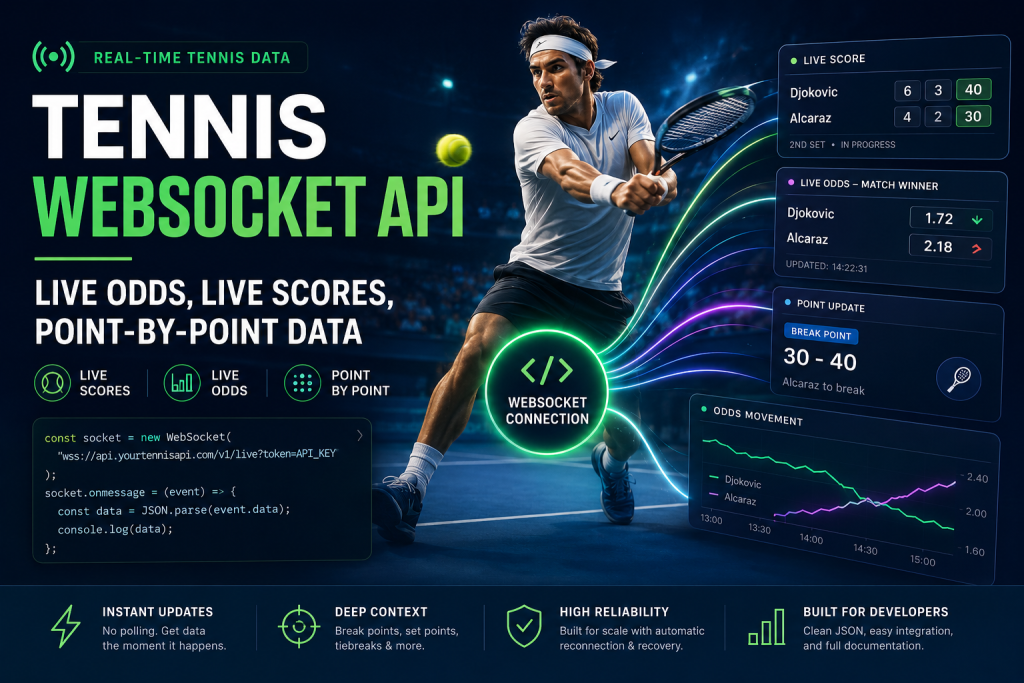
Tennis is one of the hardest sports to power with delayed data. A single point can change the match state, trigger a break point, move in-play odds, shift win probability and change the story of a match within seconds. That is why serious tennis products need more than a standard REST API.
A tennis WebSocket API allows developers to stream live scores, live odds, point-by-point updates and match events in real time. Instead of polling an endpoint every few seconds, your application keeps an open connection and receives updates as soon as the match changes.
For live-score apps, betting dashboards, trading tools, media widgets, AI commentary systems and tennis analytics platforms, this is the difference between showing a score and understanding the match as it happens.
What Is a Tennis WebSocket API?
A tennis WebSocket API is a real-time data connection that streams tennis updates directly to your application. Instead of repeatedly asking a server for the latest score, odds or point result, your app opens a persistent connection and listens for updates.
A traditional REST API request might look like this:
GET /v1/matches/live
GET /v1/matches/{match_id}/score
GET /v1/matches/{match_id}/odds
A WebSocket connection looks more like this:
const socket = new WebSocket("wss://api.yourdomain.com/v1/live?token=API_KEY");Once connected, the server can push updates automatically whenever something changes. For example, a point update could be streamed like this:
{
  "type": "point_update",
  "event_id": "evt_982734",
  "sequence": 184,
  "match_id": "match_123",
  "server": "player_a",
  "returner": "player_b",
  "point_winner": "player_b",
  "score_before": {
    "sets": "1-0",
    "games": "3-2",
    "points": "30-40"
  },
  "score_after": {
    "sets": "1-0",
    "games": "3-3",
    "points": "0-0"
  },
  "point_context": {
    "break_point": true,
    "break_point_converted": true,
    "set_point": false,
    "match_point": false
  },
  "timestamp": "2026-06-08T14:22:16Z"
}
This real-time structure is ideal for tennis because the meaning of the score can change very quickly. A score of
30-40 is not just another point. It may be break point, set point, match point or one of the most
important moments of the match.
Who Needs a Tennis WebSocket API?
A tennis WebSocket API is useful for any product where delayed data creates a poor user experience. If users need to react to a point, break of serve, odds movement or match-status change, WebSocket data is usually a better fit than repeated REST polling.
Common use cases include:
- Live tennis scoreboards
- Sports betting dashboards
- In-play odds monitoring tools
- Trading and risk-management platforms
- Tennis prediction models
- Media and broadcast graphics
- AI match commentary systems
- Player performance dashboards
- Tennis statistics websites
- Notification and alert systems
- Fantasy tennis products
- Odds comparison platforms
If your product needs to react to break points, set points, match points, retirements, suspensions, market suspensions or point-by-point updates, a real-time tennis feed gives users a much better experience.
Why Tennis Is Perfect for WebSocket Data
Tennis is uniquely suited to real-time data because every point has context. Some points are low leverage. Others can decide a game, set or match. A single service game can include multiple break points, momentum shifts, odds movements and emotional turning points.
A strong live tennis API can capture:
- Current server
- Point winner
- Game score
- Set score
- Match score
- Break points
- Set points
- Match points
- Tiebreak points
- Medical timeouts
- Retirements and walkovers
- Suspensions and resumptions
- Live odds movement
- Market suspension and reopening
A high-quality tennis WebSocket API should not only tell developers what the score is. It should help them understand what the score means.
REST API vs WebSocket API for Tennis Data
REST and WebSocket APIs are both useful, but they are designed for different jobs. REST is ideal for historical, structured and on-demand data. WebSockets are ideal for live, fast-changing data.
| Feature | REST API | WebSocket API |
|---|---|---|
| Historical match data | Best choice | Not ideal |
| Player profiles | Best choice | Not needed |
| Rankings and fixtures | Best choice | Not needed |
| Live scores | Possible with polling | Best choice |
| Point-by-point updates | Possible but inefficient | Best choice |
| Live odds movement | Possible with polling | Best choice |
| Real-time alerts | Limited | Best choice |
| Low-latency dashboards | Difficult | Best choice |
A complete tennis data platform should usually offer both. REST should power match archives, player profiles, rankings, tournament data, pre-match statistics and historical odds. WebSockets should power live scores, live odds, point-by-point feeds, real-time notifications and in-play analytics.
Live Scores: The Foundation of a Tennis WebSocket API
The most basic use case for a tennis WebSocket API is live scoring. A strong live-score feed should include the match status, players, tournament, current set score, current game score, server and important score context.
{
  "type": "score_update",
  "event_id": "evt_100245",
  "match_id": "match_123",
  "status": "live",
  "tournament": {
    "id": "tournament_456",
    "name": "Example Open",
    "surface": "hard"
  },
  "player_1": {
    "id": "player_a",
    "name": "Player A"
  },
  "player_2": {
    "id": "player_b",
    "name": "Player B"
  },
  "score": {
    "sets": [
      { "player_1": 6, "player_2": 4 },
      { "player_1": 3, "player_2": 2 }
    ],
    "game": {
      "server": "player_1",
      "player_1": "30",
      "player_2": "40"
    }
  },
  "event_context": {
    "is_break_point": true,
    "is_set_point": false,
    "is_match_point": false
  },
  "timestamp": "2026-06-08T14:25:00Z"
}
This is much more useful than a raw score string. The client application can immediately display “Break point Player B”, trigger a notification, update a scoreboard or highlight the point visually.
Point-by-Point Tennis Data: The Real Competitive Advantage
Live scores tell you where the match is. Point-by-point tennis data tells you how the match got there. For serious tennis apps, point-level data is one of the most valuable layers available.
Point-by-point data enables advanced metrics such as:
- Hold from 0-15
- Hold from 0-30
- Hold from 0-40
- Break from 40-0
- Immediate break-back percentage
- Break-point save rate
- Break-point conversion rate
- Tiebreak point win rate
- High-leverage points won
- Momentum after saving break point
These are the kinds of insights that make a tennis data product feel genuinely analytical rather than simply informational.
For example, a match feed could generate insights such as:
- Player A has saved 4 of 5 break points today.
- Player B has failed to convert three break chances in this set.
- Player A has won 12 of the last 15 points.
- Player B has created break points in four of Player A’s last five service games.
This kind of context is valuable for media companies, betting communities, fantasy products, AI commentary tools and live match-analysis platforms.
Live Odds: Why Market Movement Matters
Live odds add another layer of intelligence. A tennis live odds API should provide more than just current odds. It should explain how the market is moving and when the market is suspended or reopened.
A strong live odds feed should include:
- Opening odds
- Pre-match closing odds
- Current in-play odds
- Odds movement over time
- Implied probability
- Bookmaker-specific prices
- Market suspension status
- Last update timestamp
- Movement direction
- Price shortening or drifting
{
  "type": "odds_update",
  "event_id": "evt_100289",
  "match_id": "match_123",
  "market": "match_winner",
  "bookmaker": "example_bookmaker",
  "timestamp": "2026-06-08T14:27:03Z",
  "odds": {
    "player_a": 1.72,
    "player_b": 2.18
  },
  "implied_probability": {
    "player_a": 58.14,
    "player_b": 45.87
  },
  "movement": {
    "player_a": "shortened",
    "player_b": "drifted"
  },
  "market_status": "open"
}
Live odds are especially interesting in tennis because markets often react immediately to game state. A player facing break point may drift. A player saving break point may shorten. A player breaking serve may shorten significantly. A medical timeout or retirement risk may cause markets to suspend.
Raw Odds vs Implied Probability
A good tennis odds API should not only return decimal odds. It should also calculate implied probability. For decimal odds, the basic formula is:
implied probability = 1 / decimal odds
For example, odds of 2.00 imply a 50% chance before bookmaker margin. Odds of 1.50
imply 66.67%.
However, bookmaker odds usually include margin, also known as overround or vig. For analytics, it is often useful to return both raw implied probability and normalized no-vig probability.
{
  "market": "match_winner",
  "bookmaker": "example_bookmaker",
  "odds": {
    "player_a": 1.80,
    "player_b": 2.10
  },
  "raw_implied_probability": {
    "player_a": 55.56,
    "player_b": 47.62
  },
  "no_vig_probability": {
    "player_a": 53.85,
    "player_b": 46.15
  }
}
For serious betting analytics, normalized probability is often more useful than raw odds because it removes the bookmaker margin and makes price movement easier to compare.
Combining Live Scores, Live Odds and Point-by-Point Data
The strongest tennis data products combine three layers:
- Live score state
- Point-by-point event history
- Live odds movement
Individually, each layer is useful. Together, they are much more powerful. Imagine a match where Player A is
serving at 4-4, 0-40 in the final set.
A basic live-score API says:
Player A 4-4, 0-40
A better point-by-point API says:
Player A has lost three straight points on serve and is facing triple break point.
A stronger live odds API says:
Player A has drifted from 1.85 to 2.45 during this service game.
A truly valuable tennis analytics API says:
Player A historically holds from 0-40 in 21.4% of service games, but only 14.8% on clay against top-20 opponents. Player B converts 0-40 return games at 72.6%. Market implied probability has moved 18.2 percentage points in Player B’s favour during this game.
That is the difference between data and insight.
Important Tennis Events a WebSocket API Should Support
A high-quality tennis WebSocket API should not only send score changes. It should classify the meaning of each update so developers do not have to infer everything from a raw score string.
Important event types include:
match_startedmatch_suspendedmatch_resumedmatch_finishedpoint_wongame_wonset_wonbreak_pointbreak_point_savedbreak_point_convertedset_pointset_point_savedmatch_pointmatch_point_savedtiebreak_startedmini_breakmedical_timeoutretirementwalkovermarket_suspendedmarket_reopenedodds_update
This matters because the client application can move faster and avoid scoring errors. If the API already identifies break points, set points, match points and market suspensions, developers can focus on the user experience rather than rebuilding tennis scoring logic.
Best WebSocket Channels and Message Types
A modern tennis API should allow clients to subscribe only to the data they need. A user following one match should not receive every update from every match.
Useful WebSocket channels could include:
wss://api.yourdomain.com/v1/live
wss://api.yourdomain.com/v1/live/scores
wss://api.yourdomain.com/v1/live/points
wss://api.yourdomain.com/v1/live/odds
wss://api.yourdomain.com/v1/live/match-status
A client could subscribe to specific match channels:
{
  "action": "subscribe",
  "channels": [
    "match:match_123:scores",
    "match:match_123:points",
    "match:match_123:odds"
  ]
}
This keeps the feed efficient and makes it easier to scale. For a live-score website, the scores channel may be enough. For a betting dashboard, odds and point-by-point data are more important. For a media widget, key points and match-status events may be the most useful.
What Makes a Tennis WebSocket API Reliable?
Real-time tennis data is only useful if it is accurate, ordered and recoverable. A production-ready WebSocket API should include event IDs, sequence numbers, timestamps, reconnection support and correction events.
WebSockets are powerful, but they introduce engineering challenges around state management, load balancing, backpressure, protocol efficiency and monitoring. For a deeper technical discussion of operating WebSockets at scale, DraftKings Engineering published a useful article: Lessons Learned: WebSocketAPI at scale .
1. Event IDs
Every message should include a unique event ID.
{
  "event_id": "evt_982734",
  "type": "point_update",
  "match_id": "match_123"
}
This helps clients detect duplicate messages and resume after a disconnection.
2. Sequence Numbers
A sequence number helps clients process updates in the correct order.
{
  "sequence": 184,
  "type": "score_update"
}
If a client receives sequence 186 after 184, it knows event 185 may be
missing.
3. Server Timestamps
Every update should include a server timestamp.
{
  "timestamp": "2026-06-08T14:24:03Z"
}
This helps developers audit latency, debug delayed updates and order events correctly.
4. Snapshot and Delta Support
When a client first connects, it should be able to request the current match snapshot. After that, it should receive only deltas.
{
  "action": "subscribe",
  "match_id": "match_123",
  "mode": "snapshot_then_delta"
}
5. Reconnection Support
Live applications must survive disconnections.
{
  "action": "resume",
  "match_id": "match_123",
  "last_event_id": "evt_982734"
}
These details separate a basic live feed from a serious tennis WebSocket API.
Handling Corrections in Point-by-Point Tennis Data
Live tennis data can change. Chair umpire corrections, scoring feed delays, overturned calls, retirements, walkovers and suspended matches can all affect the final record.
A good WebSocket API should support correction events.
{
  "type": "correction",
  "match_id": "match_123",
  "corrected_event_id": "evt_12345",
  "reason": "score_correction",
  "previous": {
    "point_winner": "player_a"
  },
  "corrected": {
    "point_winner": "player_b"
  },
  "timestamp": "2026-06-08T14:30:18Z"
}
Correction handling is important for developers who store historical point-by-point data, calculate live analytics or trigger user notifications. Without correction events, client databases can drift away from the official match state.
Latency Matters in Live Tennis Data
For live-score applications, a delay of a few seconds may be acceptable. For odds movement, trading tools or in-play betting analytics, latency is much more important.
Developers should evaluate:
- Source latency
- Processing latency
- WebSocket delivery latency
- Client-side rendering latency
- Reconnection time
- Frequency of corrections
- Timestamp accuracy
A transparent tennis WebSocket API should make it clear whether the feed is designed for live-score display, analytics, trading support or general fan engagement. Not every product needs ultra-low latency, but every developer needs to know what level of latency to expect.
Use Cases for a Tennis WebSocket API
A real-time tennis feed can support many products:
- Live score websites
- Betting dashboards
- Trading tools
- Broadcast graphics
- Media widgets
- Tennis analytics platforms
- Fantasy tennis apps
- Player performance dashboards
- Notification systems
- AI match commentary
- In-play odds monitoring
- Market movement alerts
A betting analytics platform might use the API to detect when a player shortens after saving break point, when a player drifts despite holding serve, when odds move before a score update, or when a market suspends after a medical timeout.
A media company might use the same feed to generate live insights such as:
- “Player A has saved six break points today.”
- “Player B has won 12 of the last 15 points.”
- “Player A has held from 0-30 three times in this match.”
- “Player B is 8/9 on first-serve points in this set.”
Best Endpoints for a Tennis WebSocket API Platform
A modern tennis API should usually offer both REST and WebSocket access. REST is best for historical data and WebSockets are best for real-time updates.
Useful REST endpoints include:
GET /v1/matches/live
GET /v1/matches/{match_id}
GET /v1/matches/{match_id}/stats
GET /v1/matches/{match_id}/odds/history
GET /v1/players/{player_id}/stats
GET /v1/players/{player_id}/hold-by-score
GET /v1/players/{player_id}/pressure-points
Useful WebSocket channels include:
wss://api.yourdomain.com/v1/live/scores
wss://api.yourdomain.com/v1/live/points
wss://api.yourdomain.com/v1/live/odds
wss://api.yourdomain.com/v1/live/status
The key is consistency. The same match ID should work across live scores, odds, point-by-point data, historical timelines and player analytics.
Building Trust: Accuracy, Coverage and Transparency
For a tennis WebSocket API, trust is everything. Developers and businesses need to know exactly what they are getting.
A strong provider should be transparent about:
- Data coverage
- Supported tours
- Supported tournaments
- Latency expectations
- Odds source coverage
- Update frequency
- Historical availability
- Point-by-point availability
- Retirement and walkover handling
- Suspended match handling
- Data correction policy
If a match is delayed, suspended, corrected or missing point-level coverage, the API should say so clearly.
{
  "type": "coverage_update",
  "match_id": "match_123",
  "coverage": {
    "live_score": true,
    "point_by_point": true,
    "live_odds": false,
    "reason": "odds_not_available_for_this_market"
  }
}
This improves developer trust and reduces support requests.
Build With a Real-Time Tennis WebSocket API
If you are building a tennis product, the strongest user experience comes from combining live scores, point-by-point data and odds movement in one real-time feed.
A modern tennis WebSocket API should help developers answer:
- What just happened?
- Why did the match state change?
- How did the odds react?
- Was the point high leverage?
- Is the player under pressure?
- Is momentum shifting?
That is the standard live tennis products now need to meet. The best APIs will not only provide the score. They will provide the context behind the score.
Frequently Asked Questions
What is a tennis WebSocket API?
A tennis WebSocket API is a real-time data feed that streams tennis updates to an application over a persistent WebSocket connection. It is commonly used for live scores, point-by-point data, live odds, match status updates and in-play analytics.
Is WebSocket better than REST for live tennis scores?
WebSocket is usually better for live tennis scores because the server can push updates as soon as the score changes. REST APIs are still useful for historical data, player profiles, rankings and match archives.
Can a tennis WebSocket API provide live odds?
Yes. A tennis WebSocket API can stream live odds updates, implied probability changes, market suspensions, bookmaker prices and in-play market movement.
What is point-by-point tennis data?
Point-by-point tennis data records every point in a match, including the server, returner, point winner, score before the point, score after the point and match context such as break point, set point or match point.
Why is point-by-point data useful?
Point-by-point data allows developers to calculate advanced tennis metrics such as hold from 0-40, break point save rate, immediate break-back percentage, tiebreak performance, high-leverage points won and live momentum swings.
What data should a live tennis API include?
A live tennis API should include match status, players, tournament, court, surface, set score, game score, server, point winner, point context, match events, timestamps and optional odds movement.
How do live odds and point-by-point data work together?
Live odds show how the market prices a match. Point-by-point data explains why the odds moved. Combining both allows developers to analyze market reactions to break points, set points, service breaks, medical timeouts and momentum swings.
Should I use polling or WebSockets for live tennis data?
Polling can work for simple live-score products, but WebSockets are usually better for real-time applications because they reduce unnecessary requests and deliver updates faster.
Build Tennis Apps With Real ATP & WTA Data
Access live scores, rankings, fixtures, odds, H2H records and historical tennis data through our developer-friendly Tennis API.
Get API Access