
Tennis Betting API: Odds, Predictions, Stats & Live Match Data
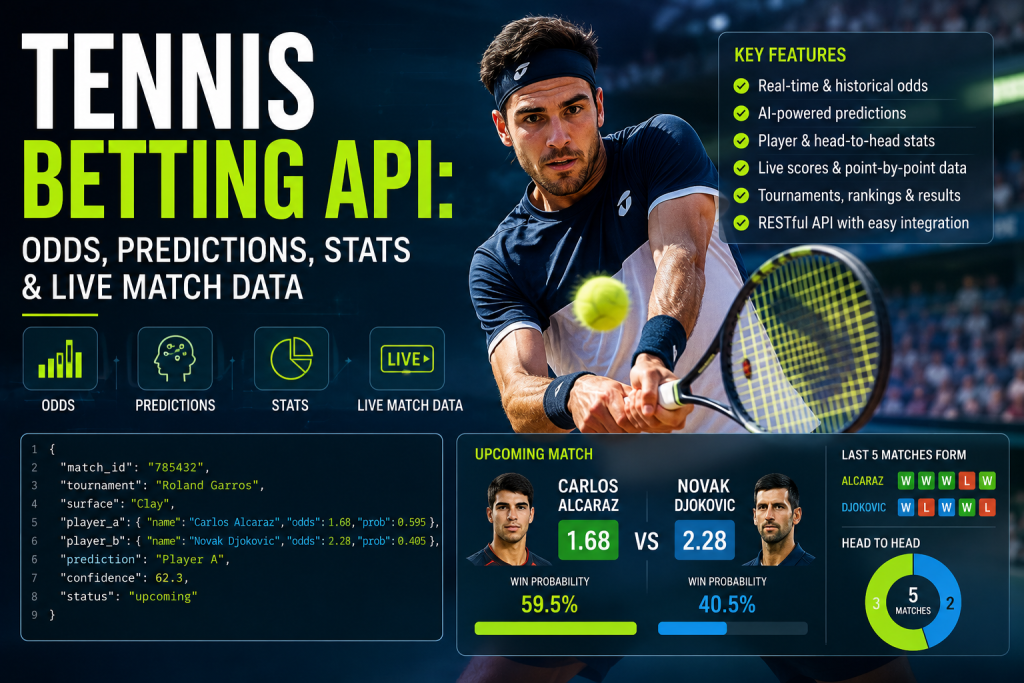
A complete guide for developers, betting analysts, sportsbook technology teams, affiliates and tennis data platforms that want to build smarter products using odds, predictions, player stats and live match data.
Introduction
A tennis betting API is the data foundation behind many modern tennis betting products. It can power odds comparison pages, prediction dashboards, live match centers, betting model tools, player analytics, automated previews and in-play trading screens. When built properly, it does more than return prices. It connects odds, predictions, stats and live match data into one usable system.
Tennis is one of the most attractive sports for betting data products because each match has a clear structure. Most matches involve two players, a known surface, a scheduled event, a defined scoring system and a measurable result. That structure makes tennis easier to model than many team sports in some ways. However, tennis is also difficult because performance can change dramatically by surface, opponent style, match format, injury status, travel schedule, recent form, pressure points and live match momentum.
A tennis betting API helps developers manage that complexity. Instead of manually collecting odds from bookmakers, scraping scoreboards, matching player names and building fragile data pipelines, a strong API provides structured endpoints for the key information that betting products need.
The best tennis betting API should support four core data layers: odds, predictions, stats and live match data. Odds show how the market prices a match. Predictions estimate expected outcomes. Stats explain player performance and matchup context. Live match data shows what is happening right now. When these layers are combined, developers can build more useful, more accurate and more trustworthy tennis products.
What Is a Tennis Betting API?
A tennis betting API is a structured data service that provides tennis betting and match information through programmatic endpoints. Depending on the provider, it may include pre-match odds, live odds, historical odds, player statistics, prediction probabilities, fixtures, results, rankings, tournament details, point-by-point data and live score updates.
The purpose of a tennis betting API is to make tennis betting data usable at scale. Developers can request data in a predictable format, store it in databases, join it with internal models and display it inside applications. This is much more reliable than manually collecting data or relying on inconsistent page scraping.
A tennis betting API can be used for:
- Odds comparison websites
- Tennis prediction platforms
- Betting model dashboards
- In-play trading tools
- Sportsbook analytics systems
- Affiliate betting content
- Live tennis score widgets
- Automated match previews
- Player comparison pages
- Historical betting research
A basic API may only return odds. A more complete tennis betting API should provide the surrounding data needed to understand those odds: match context, player strength, surface records, recent form, live score state and prediction probability.
Why Tennis Betting Products Need Multiple Data Layers
Betting products become weak when they depend on only one type of data. Odds alone show the market price, but not why the price exists. Stats alone show player performance, but not whether the market has already priced that performance in. Predictions alone may give a forecast, but not whether that forecast offers value. Live scores alone show the current match state, but not how the market is reacting.
A strong tennis betting API should help connect all of these layers.
- Odds: What the betting market currently implies.
- Predictions: What a model estimates should happen.
- Stats: Why a player may have an advantage or disadvantage.
- Live match data: What is happening during the match.
Consider a match where Player A is priced at 1.80 and Player B is priced at 2.10. The odds tell you Player A is favored. But a better betting product should explain more. Is Player A better on the surface? Has Player B been returning poorly? Is Player A carrying fatigue from a long previous match? Has the market moved since opening? Has the model probability changed during live play?
This is why a complete tennis betting API is so valuable. It turns a simple betting price into a deeper analytical product.
Odds Data: The Core of a Tennis Betting API
Odds are the most obvious component of a betting API. They represent the prices available from bookmakers or markets for specific betting outcomes. For tennis, the most common market is the match winner market, but a complete API may also include set betting, total games, game handicaps, set handicaps, outrights and live betting markets.
A useful tennis odds endpoint should provide:
- Match ID
- Player IDs
- Bookmaker ID
- Market type
- Outcome name
- Decimal odds
- Fractional or American odds where needed
- Timestamp
- Market status
- Pre-match or live flag
- Opening odds
- Current odds
- Closing odds where available
The timestamp is critical. Betting products need to know when a price was recorded. A price from six hours before a match is not the same as a price from two minutes before the match. Without timestamps, developers cannot properly calculate line movement, closing line value or model performance.
Predictions: Turning Data into Probability
Predictions are one of the most useful features a tennis betting API can provide. A prediction endpoint may return a projected winner, win probability, confidence rating, model edge, expected value or supporting factors.
The most important prediction output is probability. A simple predicted winner is not enough. If a model says Player A is likely to win, users still need to know whether Player A is a 52% favorite or a 78% favorite. Those are very different forecasts.
A strong prediction response may include:
- Predicted winner
- Win probability for each player
- Confidence score
- Model edge against market probability
- Key supporting stats
- Surface-specific context
- Recent form comparison
- Head-to-head history
- Odds comparison
Prediction APIs become much more useful when they explain the forecast. A user-facing betting product should not simply say “Player A to win.” It should explain that Player A has a better surface record, stronger recent return numbers, a favorable matchup and a model probability above the market-implied price.
Teams interested in tennis prediction data and structured tennis APIs can review resources such as The Best Tennis Data API for Stats, which discusses tennis data API use cases for stats and predictions.
Stats: The Context Behind Every Price
Player statistics are what make tennis betting analysis meaningful. Odds tell you the market price, but stats help explain whether that price may be fair. Without stats, a betting product is only displaying numbers. With stats, it can explain matchups.
Important tennis stats include:
- Current ranking
- Ranking movement
- Recent win-loss record
- Surface-specific win rate
- Serve hold percentage
- Return break percentage
- First serve points won
- Second serve points won
- Break point conversion
- Break point save rate
- Tiebreak performance
- Head-to-head results
- Performance against similar opponents
- Recent tournament performance
Surface stats are especially important. Tennis performance changes dramatically between clay, grass, hard courts and indoor environments. A player who performs well on clay may be much less effective on grass. A big server may gain extra value in faster conditions. A strong returner may be more dangerous on slower courts.
This is why a tennis betting API should organize stats by surface, tournament level and time period. Career statistics are useful, but recent surface-specific statistics are often more relevant for match prediction.
Live Match Data: The Foundation of In-Play Betting Products
Live match data is essential for any in-play tennis betting product. Once a match begins, pre-match analysis is no longer enough. The model needs to understand the live score state and how the match is developing.
Useful live match data includes:
- Current set score
- Current game score
- Current point score
- Current server
- Break point status
- Tiebreak score
- Match status
- Service games won
- Return points won
- Point-by-point sequence
- Live odds
- Market suspension status
In tennis, live probability depends heavily on the exact score state. A player leading 4-3 with a break has a very different position from a player leading 4-3 on serve. A player serving at 30-40 faces a very different risk than a player serving at 40-0.
This is why a tennis betting API that includes live match data is much more powerful than an odds-only feed. It can connect market prices to the events that caused those prices to move.
Point-by-Point Data for Advanced Tennis Models
Point-by-point data adds another layer of detail to live betting models and match analytics. Instead of only showing the current score, it shows the sequence of points that created that score.
Point-level data can reveal pressure and momentum. A player may be leading in the score but losing a high percentage of return points. Another player may be behind but creating frequent break chances. A standard scoreboard may not show that. A point-by-point API can.
Point-level tennis analysis has also been explored in research contexts. For example, this paper on point-by-point performance in tennis using Novak Djokovic as an example is a useful reference for understanding how granular point data can support deeper performance analysis.
For betting products, point-by-point data can support:
- Live win probability models
- Break point pressure indicators
- Service dominance tracking
- Return pressure analysis
- Momentum charts
- In-play alerts
- Post-match reports
How to Compare Model Probability with Market Odds
One of the most important workflows in tennis betting analysis is comparing model probability with market-implied probability.
Decimal odds can be converted into implied probability using:
implied_probability = 1 / decimal_oddsIf a player is priced at 2.00, the raw implied probability is 50%. If a player is priced at 1.50, the raw implied probability is 66.7%. If a player is priced at 3.00, the raw implied probability is 33.3%.
A betting model can then compare its own probability with the market. If the market implies 52% and the model estimates 60%, the model may see value. If the market implies 70% and the model estimates 62%, the favorite may be overpriced according to the model.
This does not mean every difference is a bet. Models can be wrong, markets can be sharp and bookmaker margin must be considered. But probability comparison is the foundation of serious betting analysis.
Historical Data and Backtesting
A tennis betting API becomes much more useful when it supports historical data. Historical odds, stats and results allow developers to test whether a model would have performed well in the past.
A proper backtest should measure:
- Prediction win rate
- Probability calibration
- Model performance by surface
- Model performance by tournament level
- Performance on favorites and underdogs
- Closing line value
- Expected value
- Return on investment
- Performance over large samples
Backtesting must avoid lookahead bias. A model should only use information that would have been available at the time of prediction. This is why timestamped historical data is so important.
Developers interested in using structured tennis data with machine learning workflows may also find this paper useful as a background reference: Data-Driven Prediction of Tennis Ranking Movements with Ensemble Machine Learning Models. Ranking movement is not the same as match betting, but the broader concept of modeling tennis outcomes with structured features is relevant to betting analytics.
Building a Tennis Betting Dashboard
A tennis betting API can power a dashboard that brings together odds, predictions, stats and live data in one interface. The goal should not be to overwhelm users with raw data. The goal should be to show the most useful signals clearly.
A strong dashboard might include:
- Upcoming matches
- Current bookmaker odds
- Opening and closing prices
- Model win probability
- Market implied probability
- Model edge
- Surface stats
- Recent form
- Head-to-head results
- Live score state
- In-play odds movement
- Closing line value tracking
For casual users, the dashboard should explain the match in simple terms. For analysts, it should provide deeper data, filters and export options. For traders, it should prioritize speed, alerts and live market movement.
SEO Use Cases for Tennis Betting APIs
Tennis betting APIs can also support SEO-focused websites. Instead of publishing thin prediction pages, publishers can create rich, data-backed match previews that include odds, model probabilities, player stats, surface analysis and betting disclaimers.
Examples of useful SEO page types include:
- Daily tennis predictions
- ATP betting previews
- WTA betting previews
- Grand Slam betting guides
- Player-vs-player prediction pages
- Odds movement pages
- Live match pages
- Historical odds reports
Search engines reward useful content. A page that only says “Player A to win” is weak. A page that explains odds movement, surface context, model probability, recent form and risk factors is much stronger.
Common Mistakes When Using a Tennis Betting API
One common mistake is treating odds as predictions without understanding bookmaker margin. Odds imply probability, but the raw probabilities include margin and should often be normalized before model comparison.
Another mistake is relying only on rankings. Rankings matter, but they do not fully capture surface performance, recent form, matchup dynamics or injury context.
A third mistake is ignoring timestamps. A price from the morning of the match is not the same as a closing price. A live price after a first-set break is not the same as a pre-match price.
Other mistakes include:
- Using player names instead of stable IDs
- Mixing ATP, WTA, ITF and Challenger data without context
- Ignoring surface-specific stats
- Not separating pre-match and live models
- Failing to track closing line value
- Overfitting models to small samples
- Publishing thin automated betting content
- Ignoring responsible gambling requirements
Final Verdict
A tennis betting API is most valuable when it brings together odds, predictions, stats and live match data. Odds show the market price. Predictions estimate probability. Stats explain player context. Live match data shows how the match is unfolding in real time.
Developers building serious tennis betting products should look for APIs with stable match IDs, reliable player IDs, bookmaker-level odds, timestamps, prediction probabilities, surface-aware stats, historical data and live match updates. These fields make it possible to build dashboards, betting models, prediction pages, live tools and long-term performance tracking systems.
The goal is not simply to display odds. The goal is to help users understand them. A strong tennis betting API makes that possible by turning fragmented betting and match information into structured, testable and useful data.
Disclaimer: This article is for informational, technical and analytical purposes only. Betting involves risk. Odds, predictions, stats and live match data do not guarantee profit. Any betting-related product, odds display, prediction page or commercial analytics tool must comply with applicable laws, licensing rules, responsible gambling requirements, advertising standards and platform policies.
Build Tennis Apps With Real ATP & WTA Data
Access live scores, rankings, fixtures, odds, H2H records and historical tennis data through our developer-friendly Tennis API.
Get API Access