
BetsAPI Tennis API vs Tennis-API.com: Which Tennis Data API Is Better for Developers?
BetsAPI Tennis API vs Tennis-API.com: Which Tennis Data API Is Better for Developers?
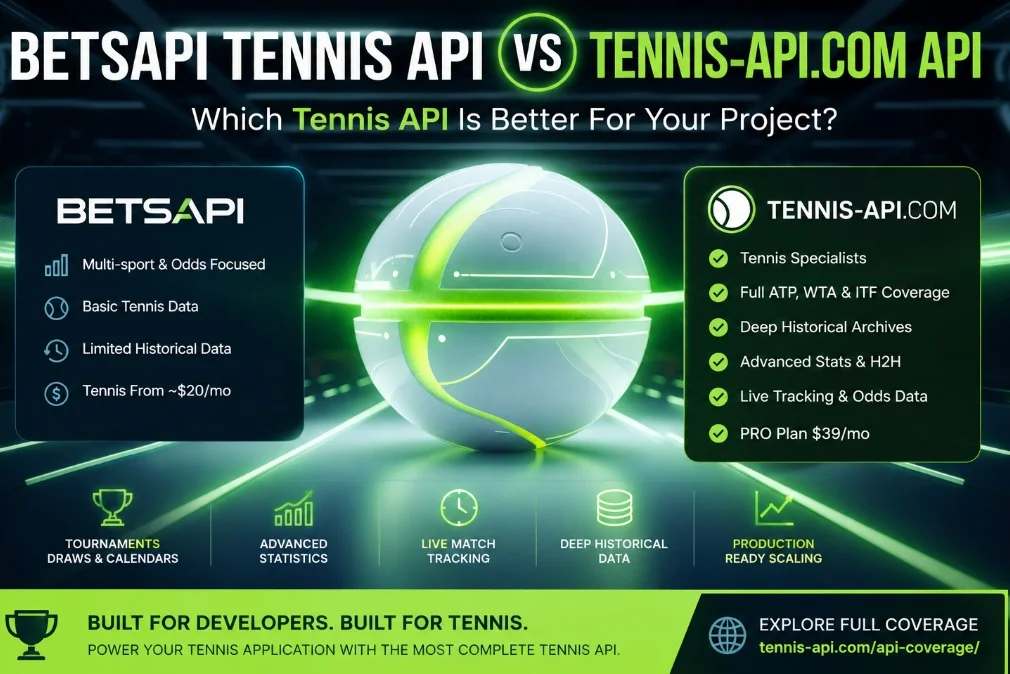
BetsAPI and Tennis-API.com are both considered by developers building tennis products, but they are not designed around the same priorities. BetsAPI is best understood as a broad sports and betting data provider. Tennis-API.com is a specialist tennis API built around tennis-specific workflows such as ATP and WTA coverage, ITF data, live scores, rankings, player profiles, H2H records, historical archives, odds, tournament calendars and tennis analytics.
The right choice depends on what you are building. If your product is a multi-sport betting dashboard where tennis is one category among many, BetsAPI may be a practical option. If your product is primarily about tennis, Tennis-API.com is usually the more natural fit because its data model is organised around the structure of the sport.
This comparison is written for developers, founders, product managers, betting analysts, sports publishers and SEO teams who need to choose a tennis data provider for a real application rather than a one-off prototype.
To review the current Tennis-API.com dataset in more detail, see the full Tennis API Coverage page.
Executive Summary
Choose Tennis-API.com if tennis is the core of your product and you need connected tennis data: live scores, ATP/WTA/ITF coverage, rankings, player profiles, H2H records, historical results, current event form, odds and tournament context.
Choose BetsAPI if your product is primarily multi-sport or odds-led and tennis is only one part of a wider betting data stack.
| Decision Factor | Better Fit | Why |
|---|---|---|
| Tennis-first app, website or SaaS product | Tennis-API.com | Built specifically around tennis product workflows and tennis-specific datasets. |
| Multi-sport betting dashboard | BetsAPI | Broad sports and odds orientation can be useful when tennis is one of many sports. |
| Historical tennis analysis | Tennis-API.com | Historical tennis archives and player context are central to the product positioning. |
| Odds across many sports | BetsAPI | Better suited to broad betting-market coverage across multiple sports. |
| Programmatic SEO tennis pages | Tennis-API.com | H2H, rankings, player profiles, results and tournament context are more relevant for tennis content pages. |
| AI tennis assistant or prediction model | Tennis-API.com | Needs clean tennis-specific entities, history, rankings, H2H and feature-ready datasets. |
How to Evaluate a Tennis API Properly
A useful tennis API comparison should go beyond a simple feature checklist. Many providers can display fixtures or live scores, but production applications often need deeper tennis-specific structure.
Before choosing a provider, evaluate these areas carefully:
- Coverage: Does the API cover ATP, WTA, ITF, Challenger, Grand Slam and qualifying-level use cases that matter to your users?
- Historical depth: Can you access enough past results for analytics, prediction models, H2H pages and player research?
- Entity consistency: Are players, tournaments and matches structured consistently across seasons?
- Live reliability: Are live scores, status changes, retirements and walkovers handled clearly?
- Odds availability: Do you need pre-match odds, live odds, market movement or broad bookmaker data?
- Developer experience: Are endpoints, response formats, limits and documentation easy to work with?
- Scalability: Can the API support your expected request volume, traffic spikes and page-generation needs?
- Total cost: Does the provider still make sense after adding usage costs, bandwidth, engineering time and required add-ons?
Quick Comparison Table
Exact features can vary by endpoint, plan, commercial package and provider updates. Use this table as a practical framework, then verify current details before committing.
| Category | Tennis-API.com | BetsAPI |
|---|---|---|
| Primary focus | Specialist tennis data API | Broad multi-sport and betting data API |
| Best fit | Tennis-first apps, analytics platforms, prediction models, media sites and tennis databases | Multi-sport betting products and odds-led sports dashboards |
| ATP and WTA data | Core product focus | Available, but inside a broader sports framework |
| ITF and lower-level tennis | Positioned as part of tennis coverage | May vary by endpoint, plan and availability |
| Historical tennis archives | Important part of the product | Useful in some contexts, but not primarily positioned as a deep tennis archive |
| Head-to-head records | Important tennis-specific feature | May be more basic depending on endpoint and use case |
| Rankings and player context | Designed for tennis analysis and content workflows | Check depth and consistency for your required features |
| Live match tracking | Built for tennis applications | Available as part of wider sports data coverage |
| Pre-match odds | Available as part of the tennis data offering | Strong fit for odds-focused products |
| Tournament draws and calendars | Useful for tennis-specific apps and content products | Confirm tennis depth before relying on it |
| Developer positioning | Practical tennis API access for developers and startups | Broad sports data access for betting and multi-sport products |
| Typical buying decision | Choose when tennis quality and structure matter most | Choose when broad sports and odds coverage matter most |
What BetsAPI Is Best For
BetsAPI is best known as a broad sports and betting data provider. It can be a sensible option if your main requirement is access to odds, fixtures and live data across many sports rather than a tennis-only data layer.
BetsAPI may be appropriate if you are building:
- a multi-sport betting dashboard;
- an odds comparison product covering many sports;
- a general sports application where tennis is a secondary category;
- a product that prioritises sportsbook market coverage over tennis-specific analysis;
- a system that already uses BetsAPI for other sports and only needs basic tennis support.
In those situations, using one broad provider can simplify integration and procurement. If your users care equally about football, basketball, tennis and other sports, a specialist tennis API may be less important than broad coverage.
Where Broad Sports APIs Can Become Limiting for Tennis Products
Tennis is not just another scoreboard sport. A strong tennis product often needs relationships between players, rankings, surfaces, tournaments, draws, rounds, historical matchups and long-term form.
These details matter when building:
- player profile pages with career records and surface splits;
- head-to-head comparison pages before upcoming matches;
- match prediction models using historical results and recent form;
- tournament draw pages with projected matchups;
- SEO pages for player-vs-player searches;
- betting research tools that combine odds, rankings and past performance;
- AI assistants that answer questions about players, form and match history.
If a broad sports API does not provide enough tennis-specific structure, your engineering team may need to build its own mapping layer for players, tournaments, rankings, surfaces and match histories. That hidden maintenance cost can become more expensive than the API subscription itself.
Why Tennis-API.com Is Different
Tennis-API.com is built specifically for tennis products. Instead of treating tennis as one category inside a larger sports database, it is positioned around the data objects tennis applications actually need.
This includes:
- ATP, WTA and ITF coverage;
- live match tracking;
- fixtures, schedules and results;
- historical match archives;
- player profiles and rankings;
- head-to-head records;
- current event form statistics;
- pre-match odds data;
- tournament draws and calendars;
- data structures suitable for analytics, prediction tools and tennis content products.
This makes Tennis-API.com a stronger fit when tennis is not a side feature but the core of the product.
Tennis-API.com PRO Plan
Tennis-API.com’s main production package is the PRO plan. At the time this source page was prepared, the plan was positioned at $39/month for production tennis products.
PRO — $39/month
- Requests: 75,000 per month
- Additional requests: $0.002 per request
- Rate limit: 7 requests/sec
- Bandwidth included: 10,240MB per month
- Extra bandwidth: $0.001 per 1MB
- ATP, WTA and ITF tennis coverage
- Historical tennis archives
- Head-to-head statistics
- Current event form data
- Live match tracking
- Pre-match odds data
- Tournament draws and calendars
- Production-oriented scaling for tennis applications
Review the latest plan details before purchase because request allowances, bandwidth, endpoints and pricing can change over time: https://tennis-api.com/pricing/
Coverage Depth: Why Tennis-Specific Structure Matters
The most important difference between a tennis-specialist API and a broad sports API is not simply how many endpoints exist. It is whether the data supports tennis-specific workflows without excessive manual work.
A serious tennis product may need to answer questions such as:
- How has a player performed on clay compared with hard courts?
- What is the head-to-head record between two players?
- Did the player recently retire from a match or play a long three-setter?
- How has a player’s ranking changed before this tournament?
- What does the draw look like and who could meet in the next round?
- How do current odds compare with historical market expectations?
- Which matches should be featured on a prediction or preview page?
These are standard requirements for tennis media websites, betting tools, analytics dashboards and prediction platforms. If the API does not make these relationships easy to access, the cost moves from the subscription fee into engineering time.
You can explore Tennis-API.com data categories here: API Coverage.
Developer Experience: Integration Speed vs Long-Term Maintainability
Developers often judge an API by how quickly they can make the first successful request. That matters, but it is only the beginning. The larger question is whether the API remains easy to work with after your product grows.
For tennis applications, long-term maintainability depends on reliable entity mapping. Player names can change format across sources. Tournaments may have sponsorship names, location changes or recurring seasonal editions. Match statuses need to handle walkovers, retirements, cancellations and rescheduling. Rankings and draws must stay aligned with dates and events.
A tennis-specialist API can reduce this burden because its data model is designed around these realities. A multi-sport API may still work well, but your team should test whether it provides enough structure for the tennis features you plan to build.
Historical Data and Prediction Models
Historical data is one of the biggest reasons to choose a specialist tennis API. Live scores are useful for real-time products, but historical archives are what make deeper analysis possible.
Developers building prediction models often need to combine several signals:
- current ranking;
- ranking movement;
- recent match results;
- surface-specific performance;
- head-to-head history;
- tournament history;
- opponent strength;
- odds or implied market probabilities.
If these datasets are fragmented or incomplete, models become harder to train and validate. Tennis-API.com is better positioned for this type of tennis-first modelling because historical records, player context and matchup data are central to the product.
Odds Data: When BetsAPI May Have the Advantage
BetsAPI’s strongest use case is often betting and odds coverage across sports. If your business depends primarily on bookmaker feeds across many sports, a broad odds-oriented provider may be attractive.
Tennis-API.com also includes pre-match odds data, but the main advantage is the combination of odds with tennis-specific context. A betting research product may not only need the price on a match. It may also need the players’ rankings, recent form, surface history, H2H record and historical results in one coherent tennis data layer.
In simple terms: if your product starts with odds and adds tennis as one category, BetsAPI may be a good fit. If your product starts with tennis analysis and uses odds as one important signal, Tennis-API.com may be the better fit.
Pricing and Total Cost of Ownership
API pricing should be evaluated as total cost of ownership, not just the lowest monthly subscription. A cheaper plan can become expensive if you need multiple add-ons, more requests, more bandwidth, or significant engineering work to clean and structure the data.
When comparing BetsAPI and Tennis-API.com, consider:
- monthly subscription fee;
- request allowance;
- rate limits;
- bandwidth limits;
- cost of extra usage;
- whether odds require separate products or additional costs;
- how much custom database work your team must do;
- whether the API supports the pages, features and models you want to build.
For a tennis-focused product, Tennis-API.com can be better value because the relevant tennis datasets are packaged around the sport itself. For a multi-sport betting product, BetsAPI may provide better value if you need broad odds coverage across many sports from one provider.
Use Case Recommendations
Choose BetsAPI if:
- you are building a multi-sport product;
- your main requirement is sportsbook odds across many sports;
- tennis is a small part of your overall product;
- you do not need deep tennis history, H2H context or tournament structure;
- your team already uses BetsAPI for other sports and wants to keep one data provider.
Choose Tennis-API.com if:
- you are building a tennis-first product;
- you need ATP, WTA and ITF tennis coverage;
- you need historical tennis records for analysis or modelling;
- you need head-to-head statistics and matchup pages;
- you need player form, rankings, tournament data and odds in one tennis layer;
- you want to build tennis SEO pages, prediction tools, analytics dashboards or AI features;
- you want tennis-specific depth without paying for unnecessary multi-sport complexity.
Practical Examples
Example 1: Live Scores Website
A basic live scores website can potentially use either provider. The decision depends on whether the site only needs live scores or whether it will later expand into rankings, H2H pages, tournament draws, player profiles and historical match content. If expansion into tennis content is part of the roadmap, Tennis-API.com is likely the safer long-term fit.
Example 2: Betting Odds Dashboard
A dashboard focused on many sports and many bookmaker markets may prefer BetsAPI. A tennis-only betting research dashboard that combines odds with player form, rankings, historical results and H2H data may be better suited to Tennis-API.com.
Example 3: Tennis Prediction Model
Prediction models need historical depth and clean feature engineering. Tennis-API.com is stronger for this use case because the product is positioned around tennis-specific historical and analytical data rather than broad sports coverage.
Example 4: Programmatic SEO Tennis Website
A site creating player pages, match preview pages, H2H pages, rankings pages and tournament pages needs consistent tennis entities and historical context. Tennis-API.com is the better fit for this type of product because the API is designed around tennis content relationships.
Questions to Ask Before Choosing Either API
Before you commit to BetsAPI, Tennis-API.com or any other provider, ask these questions:
- Which tours and tournament levels do we need?
- Do we need only current data or also historical archives?
- Will we build H2H, rankings, player profile or prediction features?
- How important are odds compared with tennis statistics?
- How many monthly requests will production traffic require?
- Do we need data for frontend pages, backend models or both?
- How much engineering time are we prepared to spend normalising data?
- Can the provider support our commercial use case and traffic levels?
A short proof of concept is often the best way to decide. Test the endpoints that map to your real product features, not only the easiest endpoint to call.
Final Verdict
BetsAPI and Tennis-API.com can both be useful, but they fit different products.
BetsAPI is a better fit for multi-sport betting products, odds-led dashboards and teams that want one broad provider across many sports.
Tennis-API.com is a better fit for tennis-first products that need ATP, WTA and ITF coverage, historical data, rankings, H2H records, player form, tournament context, odds and tennis-specific analytics.
If tennis is central to the user experience, choose the provider that reduces tennis-specific engineering work. For most tennis apps, prediction systems, SEO websites and analytics dashboards, that means starting with a tennis-focused data layer.
FAQ
Is BetsAPI better than Tennis-API.com?
BetsAPI may be better for broad multi-sport betting products. Tennis-API.com is usually a better fit for tennis-first products that need deeper tennis context, historical data, H2H records, rankings and player analysis.
Is Tennis-API.com only for live scores?
No. Tennis-API.com is positioned around connected tennis datasets including live scores, fixtures, rankings, player profiles, H2H records, historical archives, odds and tournament data.
Which API is better for tennis prediction models?
Tennis-API.com is generally the stronger fit for tennis prediction models because modelling requires historical results, rankings, H2H context, player form, surface records and consistent tennis entities.
Which API is better for odds across many sports?
BetsAPI may be the better option if your main requirement is broad odds coverage across many sports rather than deep tennis-specific data.
Should I test both APIs before deciding?
Yes. The best approach is to test each provider against your actual product requirements, including coverage, data structure, response quality, request limits, documentation and total cost.
Build Tennis Apps With Real ATP & WTA Data
Access live scores, rankings, fixtures, odds, H2H records and historical tennis data through our developer-friendly Tennis API.
Get API Access