
The Complete Tennis API Developer Guide: Live Scores, Rankings, Stats, Draws, Odds, Predictions and AI
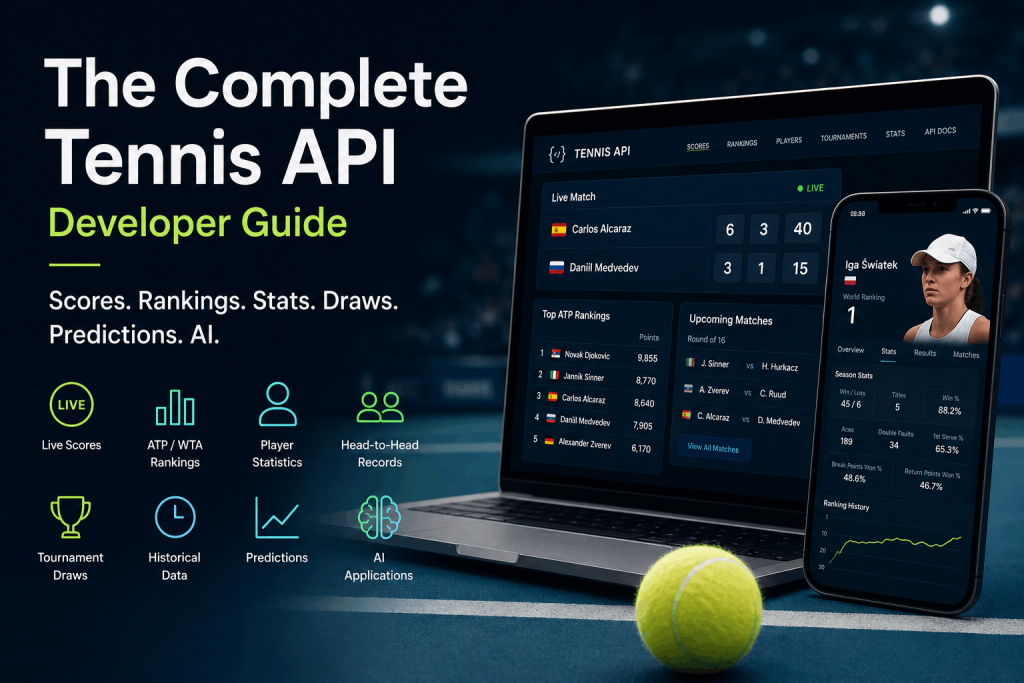
A good tennis application is only as reliable as the data layer behind it. Live scores, rankings, player profiles, tournament draws, odds, historical results and prediction features all depend on the same foundation: clean, structured and consistently updated tennis data.
This guide explains how developers can use a tennis API to build real products, not just simple score widgets. It covers the main tennis data categories, the technical decisions that matter in production, and the differences between building with structured API data and trying to maintain tennis data manually or through scraping.
The focus is practical. If you are building a live scores website, an ATP and WTA rankings page, a player statistics dashboard, a head-to-head comparison tool, a betting research product, a tournament draw explorer, a prediction model or an AI tennis assistant, this guide shows how the core data pieces fit together.
For a full breakdown of available endpoints and data categories, see the Tennis API coverage page.
Quick Summary
A modern tennis API should help developers connect live match data with player, ranking, tournament, historical and analytical context. The best tennis products do not display isolated scores; they connect scores to meaning.
| Product Type | Most Important Data | Key Technical Requirement |
|---|---|---|
| Live score app | Live matches, fixtures, scores, status, tournaments | Fast updates, caching and clear status handling |
| Rankings website | ATP/WTA rankings, movement, points, player IDs | Stable player mapping and ranking snapshots |
| H2H comparison tool | Player records, previous meetings, surface splits | Reliable historical match linking |
| Prediction model | Historical results, rankings, surface stats, odds, form | Time-safe feature generation and backtesting |
| Betting dashboard | Odds, live scores, market movement, player context | Timestamps, freshness, compliance and reliability |
| AI tennis assistant | Structured current and historical tennis data | Entity consistency and retrieval-grounded responses |
Table of Contents
- What Is a Tennis API?
- Understanding the Tennis Data Model
- Endpoint Planning for Tennis Products
- Live Tennis Scores API
- ATP and WTA Rankings API
- Point-by-Point Tennis API
- Tennis Player Statistics API
- Head-to-Head Tennis API
- Tournament Draws API
- Historical Tennis Data API
- Tennis Prediction API and Model Features
- Tennis Odds API
- AI Tennis Applications
- Production Considerations for Developers
- SEO and Programmatic Tennis Pages
- How to Choose the Best Tennis API
- Frequently Asked Questions
What Is a Tennis API?
A tennis API is a programmatic service that gives developers access to tennis data in a structured format, usually through REST endpoints returning JSON. Instead of collecting scores, rankings, fixtures, match statistics, odds and player information manually, an application can request the data it needs and display it inside a website, mobile app, dashboard, model or internal system.
A modern tennis API can support many different product types. A simple app may only need live scores and fixtures. A sports media website may need rankings, player profiles, H2H records and tournament pages. A betting analytics platform may need historical results, odds, opening prices, closing prices and surface-specific form. An AI product may need a wider data layer so the model can answer questions using real match and player information rather than general knowledge. A lot of Big Data analysis is a given
The main advantage of an API is consistency. Tennis data is messy when collected from unstructured pages: player names vary, tournaments change sponsors, qualifying rounds can be separated from main draws, retirements and walkovers require special handling, and rankings update on a schedule. A well-designed API reduces that complexity and gives developers stable objects they can build around.
If you are deciding between API integration and collecting data from websites, read the companion guide: REST API vs scraping tennis data: which is better?
Understanding the Tennis Data Model
Before choosing endpoints, it helps to understand the core entities inside a tennis product. Most tennis applications are built around the same data model:
- Players: names, IDs, country, rankings, handedness where available, career records and profile data.
- Matches: player one, player two, tournament, round, surface, status, score, winner and match time.
- Tournaments: event name, tour, category, location, dates, surface, draw size and rounds.
- Rankings: current rank, points, movement and historical ranking snapshots.
- Statistics: serve metrics, return metrics, break points, aces, double faults and other performance indicators.
- Odds: bookmaker prices, opening odds, closing odds, live odds and market movement.
- Draws: bracket structure, rounds, opponents, progression and possible future matchups.
The quality of a tennis API depends partly on how well these entities connect. A player profile becomes more useful when it links to current ranking, recent matches, surface records and upcoming fixtures. A match page becomes more valuable when it connects to H2H history, odds, player form and tournament context. A tournament page becomes more engaging when it includes draws, rankings, match schedules and player paths.
Recommended Entity Relationships
| Entity | Should Link To | Why It Matters |
|---|---|---|
| Player | Matches, rankings, H2H, tournaments, statistics | Supports player pages, predictions and analytics. |
| Match | Players, tournament, round, odds, stats, H2H | Creates rich match pages and live score experiences. |
| Tournament | Draws, fixtures, players, results, surface | Supports event hubs and archive pages. |
| Ranking | Player, date, points, movement | Enables ranking history and player-level context. |
| Odds | Match, market, timestamp, player | Supports betting dashboards and model benchmarking. |
Endpoint Planning for Tennis Products
Endpoint planning should follow product requirements. Do not request every dataset on every page. Separate fast-changing live data from slower data such as rankings, player profiles and historical results.
| Endpoint Category | Typical Use | Refresh Strategy |
|---|---|---|
| Live scores | Scoreboards and match centres | High frequency during active matches |
| Fixtures | Schedules and upcoming match pages | Moderate refresh, especially during active tournaments |
| Results | Completed match pages and archives | Refresh until final status is confirmed, then cache longer |
| Players | Player profiles and linking | Cache longer |
| Rankings | Rankings pages and player context | Refresh on ranking update schedule |
| H2H | Match previews and comparison pages | Refresh before match pages and scheduled fixtures |
| Historical data | Analytics, models and archives | Cache or store where permitted |
| Odds | Betting dashboards and market analysis | Timestamp carefully; refresh depends on market type |
Live Tennis Scores API
Live scores are one of the most common reasons developers look for tennis data. Fans want to know which matches are in progress, what the current score is, which set is being played, whether a match is delayed, and which matches have finished.
A live tennis scores API can power live scoreboards, mobile apps, tournament widgets, sports media modules, betting dashboards and fan notification systems. Typical live score data includes current matches, match status, set scores, game scores, completed results, scheduled fixtures and sometimes point-level updates.
The most important production requirements are update speed, status accuracy and coverage. In tennis, a match can be scheduled, delayed, suspended, retired, completed or won by walkover. If your application does not handle those states properly, users will quickly lose trust.
For a practical implementation walkthrough, see how to build a live tennis scores app using a tennis API.
Common Live Score Features
- Today’s matches by tour or tournament
- Live match status and score updates
- Completed results
- Upcoming fixtures
- Player and tournament links
- Match notifications and alerts
- Live widgets for publisher websites
ATP and WTA Rankings API
Rankings are a core part of almost every tennis product. They provide context for match previews, player pages, tournament seedings, editorial content and predictive models.
A tennis rankings API can provide current rankings, player positions, ranking points, ranking movement and, where available, historical ranking data. If your product covers both men’s and women’s tennis, an ATP and WTA tennis API helps you serve both tours through one consistent data source.
Rankings work best when combined with other data. On their own, rankings show a player’s official position. Combined with recent form, surface record, head-to-head history and tournament results, they become much more useful for analysis.
Useful Ranking API Features
- Current ATP and WTA rankings
- Ranking points
- Weekly movement
- Player profile links
- Historical ranking snapshots
- Ranking filters by tour, country or range
Point-by-Point Tennis API
Point-by-point data is one of the most valuable tennis datasets for advanced products. Final scores tell you the outcome. Set scores tell you the broad shape of the match. Point-by-point data shows how the match actually developed.
A tennis point-by-point API can support live match trackers, momentum charts, pressure-point analysis, win probability models, betting tools and interactive fan experiences.
This data is useful because tennis outcomes often turn on a small number of key points. A player may win in straight sets but face repeated break points. Another may lose despite winning more total points. Point-level data helps applications explain those differences.
Point-by-Point Use Cases
- Live point timelines
- Momentum visualisations
- Break-point and tiebreak analysis
- Pressure performance metrics
- In-play win probability models
- Post-match summaries based on key turning points
Tennis Player Statistics API
Scores tell users what happened. Statistics help explain why it happened. A tennis statistics API can provide the metrics needed for player comparisons, match reports, model features and editorial analysis.
Useful tennis statistics include aces, double faults, first-serve percentage, first-serve points won, second-serve points won, break points saved, break points converted, return points won, service games won, return games won and match duration.
Surface context is especially important. A player’s serve numbers on grass may look very different from their clay-court numbers. A good tennis analytics product should let users compare performance by surface, tour level, tournament, opponent quality and time period.
Common Statistics Features
- Match-level statistics
- Player season statistics
- Surface-specific performance
- Service and return breakdowns
- Recent form indicators
- Opponent-adjusted comparisons where available
Head-to-Head Tennis API
Head-to-head records are among the most searched and most engaging tennis data types. Before a match, users often want to know how many times two players have met, who leads the rivalry, who won the most recent meeting and whether the pattern changes by surface.
A tennis head-to-head API can return total meetings, wins by player, recent encounters, tournament context, surface splits and historical match results between two players.
H2H data is useful for match previews, prediction pages, betting research, sports media articles and programmatic SEO pages. Searches involving two player names often have high intent, especially around major tournaments.
H2H records should be used carefully, though. A 5-1 record may look decisive, but it may be less meaningful if the matches happened many years ago, on a different surface, or before one player’s ranking improved significantly. The strongest products combine H2H with recency, surface and player form.
Tournament Draws API
Tournament draw data helps users understand how an event is structured. Draws are especially important for Grand Slams, ATP and WTA events, Challenger tournaments and ITF competitions where users want to follow player progression through each round.
A tournament draws API can support bracket pages, tournament hubs, projected matchup tools, draw difficulty analysis and fan-facing prediction features.
Draw data becomes more valuable when combined with rankings, seedings, H2H records and recent form. A tournament page can show not only who plays whom, but also the likely path a player must take to reach the final.
Useful Draw Features
- Main draw and qualifying draw structures
- Rounds and match progression
- Seeds and player rankings
- Completed and upcoming matches
- Potential future matchups
- Links to player and match pages
Historical Tennis Data API
Historical tennis data is essential for serious analytics. Live data tells you what is happening now; historical data lets you test ideas, compare eras, train models and understand long-term performance patterns.
A historical tennis data API may include past match results, tournament results, player performance records, ranking history, surface splits, odds history and statistical archives.
Historical depth matters because tennis analysis needs sample size. A model trained only on recent matches may overreact to short-term form. A system with years of historical data can evaluate player performance across surfaces, tournament categories, ranking ranges and opponent types.
Historical Data Use Cases
- Machine learning training datasets
- Backtesting prediction models
- Player development analysis
- Surface performance research
- Historical rankings pages
- Long-term betting market studies
Tennis Prediction API and Model Features
Tennis prediction products combine multiple datasets to estimate match outcomes. A tennis predictions API or prediction-focused data layer can support win probability tools, match previews, betting research products and tournament simulations.
A basic prediction model might use ranking difference, recent wins and H2H record. A more advanced model may include surface-specific Elo-style ratings, serve and return statistics, fatigue indicators, opponent quality, tournament history, odds movement and point-by-point pressure metrics.
For a practical guide, read how to build a tennis prediction model using tennis API data.
Example Prediction Features
- Current ranking and ranking points
- Recent form over the last 5, 10 or 20 matches
- Surface-specific win rate
- Head-to-head record and recency
- Serve and return performance
- Break-point performance
- Tournament category and round
- Travel, schedule and match load proxies
- Opening and closing odds where available
No model can predict tennis perfectly. The goal is not certainty; it is better probability estimation. Good data helps developers build models that are testable, explainable and consistently improved over time.
Tennis Odds API
Odds data gives applications a market-based view of match probability. While rankings and statistics describe players, odds show how bookmakers and betting markets priced a matchup at a specific moment.
A tennis odds API can support odds comparison pages, betting dashboards, implied probability calculations, market movement charts and model evaluation.
Odds are most useful when connected with tennis context. A match preview can combine market prices with rankings, H2H history, surface form, recent results, injury context where available and prediction model output. Historical odds also help analysts compare model forecasts against closing market probabilities.
Odds Data Features to Consider
- Pre-match odds
- Opening prices
- Closing prices
- Live odds
- Bookmaker coverage
- Historical odds archives
- Implied probability calculations
AI Tennis Applications
AI tools become more reliable when they are grounded in structured data. A tennis API can provide the data layer for AI assistants, automated match previews, player comparison tools, tournament analysis systems and prediction explainers.
Instead of asking an AI model to rely on general memory, developers can retrieve live and historical tennis data, pass relevant records into the model, and generate responses based on current structured information.
AI Tennis Use Cases
- Automated match summaries
- Player comparison reports
- Natural-language rankings queries
- Tournament draw explanations
- Prediction model explainers
- AI chatbots for tennis websites
- Personalised fan alerts and insights
For AI products, data freshness and entity consistency are especially important. If a model cannot reliably distinguish between players with similar names or retrieve the latest match status, the user experience suffers. Clean player IDs, match IDs and tournament IDs make AI integrations much more dependable.
Production Considerations for Developers
Choosing a tennis API is not only about the number of endpoints. Production systems need stability, clear documentation and predictable performance.
1. Entity IDs and Data Consistency
Tennis products should avoid relying only on player names. Names can be spelled differently across sources, include accents, change ordering or collide with similar names. Stable player, tournament and match IDs are essential for a reliable database.
2. Caching Strategy
Not all tennis data needs to be refreshed at the same frequency. Live scores may need frequent updates during active matches. Rankings may update weekly. Historical records can be cached much longer. A good application separates fast-changing data from slow-changing data.
3. Rate Limits and Traffic Spikes
Grand Slam events can produce traffic spikes. Developers should understand request limits, caching options and fallback behaviour before launching public pages or mobile notifications.
4. Error Handling
Tennis has unusual match states: retirements, walkovers, suspensions, postponements and abandoned matches. Your application should display those states clearly rather than forcing every match into a normal completed-score format.
5. Documentation Quality
Good documentation reduces integration time. Look for clear endpoint descriptions, authentication examples, sample JSON, status code explanations and guidance on common workflows such as retrieving today’s matches, building player pages or displaying rankings.
Production Checklist
- Use stable IDs where available.
- Separate live data from stable data.
- Cache player profiles, tournaments and historical results appropriately.
- Handle scheduled, live, suspended, retired, walkover and completed statuses.
- Log failed requests and show graceful fallback states.
- Monitor request volume during Grand Slams and major finals.
- Validate generated SEO pages before indexing at scale.
- Document which endpoints power each major feature.
SEO and Programmatic Tennis Pages
Tennis APIs can support large-scale sports publishing, but data alone is not enough. Search users want useful answers, not thin database pages.
High-value page types include:
- Player profile pages
- Live score pages
- Match preview pages
- Head-to-head comparison pages
- Tournament schedule and draw pages
- ATP and WTA rankings pages
- Historical result archives
- Odds and prediction pages where appropriate
To improve content quality, pages should include clear dates, tournament context, player links, internal navigation, original summaries, visible data freshness and schema markup where appropriate.
Useful Structured Data Types
- SportsEvent for match pages
- ItemList for rankings and schedules
- BreadcrumbList for navigation
- FAQPage for guide pages
- WebPage for general page context
Schema should match visible page content. Do not mark up information that users cannot see.
How to Choose the Best Tennis API
The best tennis API depends on what you are building. A live scores widget, a sports media network, a sportsbook, a prediction engine and an AI tennis assistant all have different requirements.
If you are comparing providers, read the best tennis APIs for developers in 2026 for a broader evaluation.
Choose Based on Use Case
| Use Case | Most Important Data | Key API Requirement |
|---|---|---|
| Live score app | Live matches, status, set scores, fixtures | Fast updates and reliable status handling |
| Rankings website | ATP/WTA rankings, ranking points, movement | Fresh ranking snapshots and player IDs |
| Prediction model | Historical results, form, surface stats, H2H, odds | Historical depth and consistent features |
| Betting dashboard | Odds, market movement, live scores, stats | Odds coverage and update reliability |
| AI tennis assistant | Structured player, match, ranking and tournament data | Entity consistency and current data access |
| Sports publisher | Players, rankings, H2H, tournaments and results | Strong internal linking and scalable data quality |
Conclusion
A modern tennis API is more than a live score feed. It is the foundation for live match centres, rankings pages, player profiles, H2H tools, tournament draws, betting dashboards, prediction models, AI assistants and SEO-driven tennis content.
The strongest tennis products connect multiple datasets: live scores, rankings, historical results, player statistics, H2H records, tournament context, odds and predictions. This connected structure helps users understand not only what happened, but why it matters.
For developers, the right API reduces data maintenance, improves product reliability and gives your team more time to build features that users actually value.
Frequently Asked Questions
What is a tennis API?
A tennis API is a service that provides tennis data through structured endpoints, usually returning JSON. It can include live scores, fixtures, rankings, players, tournaments, H2H records, odds and historical results.
Can a tennis API power a live score app?
Yes. A tennis API can provide live matches, scores, match status, fixtures and completed results for live score websites and mobile apps.
What data is most important for tennis prediction models?
Prediction models usually need historical results, rankings, recent form, surface performance, H2H records, player statistics, tournament context and odds where available.
Can tennis API data be used for SEO pages?
Yes. Tennis API data can support player pages, rankings pages, H2H comparisons, tournament pages and match previews, but the pages should include useful context and not only raw data tables.
Is scraping tennis data a good alternative to an API?
Scraping may work for small experiments, but APIs are usually better for production apps because they provide more reliable, structured and scalable data access.
What should developers check before choosing a tennis API?
Check coverage, endpoint documentation, response structure, player IDs, historical depth, rate limits, pricing, support, odds availability and whether the API fits your product use case.
Build Tennis Apps With Real ATP & WTA Data
Access live scores, rankings, fixtures, odds, H2H records and historical tennis data through our developer-friendly Tennis API.
Get API Access